Exploring Milan's Chinatown: What It's Really Like
An honest guide to Milan‘s Chinatown from someone who has been to China
Share this post:
🗺️ Location: Via Paolo Sarpi area, Milan, Italy
🚇 Nearest metro: Moscova (M2) or Garibaldi FS (M2/M5)
⏱️ Time needed: Half a day for food and exploring
🗣️ Languages: Italian, Mandarin, English
🍜 Best for: Regional Chinese food you won't find in most European cities 💡 Vibe: Local, young, trendy — not touristy at all
Milan's Chinatown, centered on Via Paolo Sarpi, is one of Europe's oldest and most authentic Chinese neighborhoods — a living community, not a tourist attraction. What sets it apart is the variety of regional Chinese restaurants (Sichuan, Yunnan, Xi'an, Jiangxi and more), trendy bubble tea shops mirroring current Chinese trends, and well-stocked Chinese supermarkets. It's the best place in Italy to experience real Chinese food diversity, and a great preview if you're considering a trip to China — though the real thing is on another level.
In Zurich where I live authentic Chinese food scene doesn‘t really exist — Switzerland is not the easiest place to settle for immigrants and therefore the Chinese people who come here are usually skilled white collar employees of multinational corporations or researchers, or spouses of Swiss citizens.
So when a friend recommended we visit Milan Chinatown, I was all in — although my expectations of the food were still relatively low. But now having visited, and beinig lucky enough to have Chinese friends help me navigate it, I know that I will be coming back, whenever next China trip just feels too far away.
What Even Is a Chinatown?
Chinatowns exist in cities all over the world, from San Francisco to London to Sydney. They formed as Chinese immigrants — often from the same region or even the same village — settled together, built businesses, and created community hubs far from home. Most of the world's major Chinatowns trace back to migration waves in the 19th and early 20th centuries.
What's fascinating is how differently they've evolved. Some, like the ones in San Francisco or London, have become major tourist attractions with ornamental gates and dragon-decorated streetlamps. Others stayed working neighborhoods where the local Chinese community actually lives and shops. Milan's Chinatown falls firmly in the second category — and that's what makes it interesting.
There's also a pattern I've noticed with immigrant communities, and I've seen it first hand. What often happens — or used to happen before social media and cheap flights kept people connected to home — is that diaspora communities would stay somewhat isolated from both the local culture and from changes happening back in the country of origin. They'd become a kind of time capsule, a snapshot of the country at the moment people left.
I saw this vividly in the Polish neighborhood in Chicago, which used to be the second biggest "Polish city" in the world because of the size of the diaspora. The food, restaurants, shops — it all looked like Poland in the 1980s or 90s. Nothing like the Poland I knew from home. And even in Zurich, the Chinese shops have this same feeling — a bit old, a bit dusty, with cheaply packaged goods that don't reflect modern China at all.
Milan's Chinatown completely breaks this pattern. And that's what surprised me most.
A Quick History of Milan's Chinatown
Milan's Chinese community dates back to the 1920s, when immigrants from the Zhejiang province — particularly from around Wenzhou and Qingtian — arrived to work in the leather and textile trades. They settled around Via Paolo Sarpi and the surrounding streets, due to low rents and convenient location with proximity to the train statin. Over the decades, the neighborhood grew into one of the oldest and most established Chinatowns in Europe.
Unlike Chinatowns that were built for tourists, Via Paolo Sarpi became a pedestrian zone that serves local Chinese and Italian residents alike. The businesses here — wholesale traders, fabric shops, import businesses — existed for the Chinese community first. But as time passed, those relocated or disappeared. The restaurants and cafés that came to feed the people who worked and lived here slowly expanded into the main feature of the street. With the growing interest in Chinese cuisine and new wave of immigration of students and young professionals, the area evolved and gentrified, although seems it still mostly serve local Milan residents.
However, that community origin still defines the feel of the place today.
What It's Actually Like
Here's what I expected: an older, somewhat dated neighborhood with a few Chinese restaurants and grocery stores, maybe some lanterns and Chinese signage. Basically, a bigger version of what I know from Zurich or what I have seen in other Chinatowns.
Here's what I found: a vibrant, modern, young neighborhood that felt genuinely connected to what's happening in China right now.
The first thing that struck me was the people. The main customers weren't tourists snapping photos — they were young Chinese people. Diaspora kids, second-generation immigrants, Chinese students and tourists traveling through Europe, many in fashionable clothes that wouldn't look out of place in Shanghai or Chengdu. Mixed in were young Italians who clearly knew the neighborhood well. It had the energy of a cool hangout, not a cultural museum.
The trends I recognized from China were everywhere. Bubble tea and fruit tea shops lined the streets — and they were genuinely similar to what I know from cities like Chengdu and Shenzhen. The branding, the menus, the presentation — it all felt current, not like some watered-down import from ten years ago.
Which brings me to my favorite encounter: the fake ChaPanda. If you've been to China, you might know ChaPanda (茶百道, Cha Bai Dao) as one of the country's biggest bubble tea chains. We spotted what looked like a ChaPanda location on the street — it was called "ChaBaiDao," which is simply the pinyin romanization of the Chinese name. We assumed it was just the European branding of the same chain. But our local friend laughed and confirmed it's actually a fake — an imitation riding on the brand's popularity. I found this wonderfully ironic given that China itself is known for brand imitation. In Milan's Chinatown, the tables had turned.
The streets themselves were less atmospheric than a Chinese city, I'll be honest. A bit more worn, a bit dirtier than the meticulously maintained pedestrian streets you'd find in a place like Beijing's Wangfujing or a modern Chinese shopping district.
One thing we learned quickly: walk off the main street. Via Paolo Sarpi is the central street, but the side streets are where we found more authentic restaurants and shops. It paid off every time we turned a corner.
In the evening, the vibe shifted. The neighborhood became more of a going-out destination — aperitivo spots, late-night dining, people drinking on the streets. Very Italian in that way, and very different from how evenings feel in Chinese cities. It was fun, but probably less family-friendly than a typical evening out in China (where kids are welcome everywhere, even at 10 PM). We definitely felt old compared to the crowd — most people roaming the streets in the evening were 20 something year olds.
Map of the Chinatown
The Food, and how does it compare to China
This section deserves its own heading because the food was genuinely the highlight of the visit — and the biggest surprise.
What I expected was the standard Chinese restaurant offering I can get in Zurich: rice with meat or fish in some kind of sauce, a selection of dumplings, maybe some spring rolls. Solid but predictable — and clearly my expectations were way too low.
What I found was a completely different level of variety and regional depth.
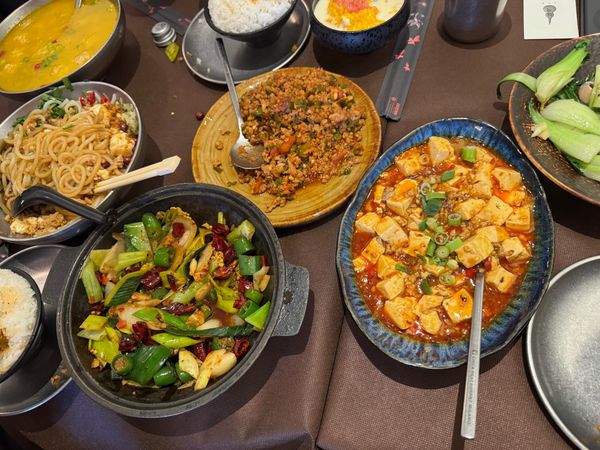
Milan's Chinatown has restaurants focused on specific regional Chinese cuisines — not just "Chinese food" as a generic category. I spotted Sichuan restaurants, Yunnan restaurants, Jiangxi places, Xi'an-style noodle shops, and more. This is the kind of regional diversity you'd expect in a large Chinese city, and finding it in a European neighborhood genuinely impressed me.
The noodle dishes in particular stood out. Freshly made noodles — hand-pulled, knife-cut, the real thing — in a variety of preparations I don't see in Swiss Chinese restaurants. There were soups I'd never tried, dishes I couldn't identify, and flavors that took me right back to eating in China.
This is where having Chinese friends made all the difference. Left to my own devices, I would have ordered the dishes I already knew. But my friends navigated the (often Chinese-only) menus, asked staff for recommendations, and ordered things I never would have tried. If you visit with Chinese friends, lean on their knowledge — it's worth it.
Beyond Chinese restaurants, there was also a solid selection of Korean and Japanese places, plus the inevitable less-authentic, more-generic Asian restaurants that cater to a broader crowd. You'll know the difference — the regional Chinese places are the ones with Chinese-language menus and Chinese customers.
And then there are the bubble tea and fruit tea shops. So many of them. If you've developed a bubble tea habit in China (guilty), you'll feel right at home. The quality and style are very close to what you'll find in Chinese cities.
Recommended restaurants:
Chifa
📍Viake Montello 5, 20154 Milano
Noodles King
📍Via Bramante 26, 20154 Milano
Xi‘an BiangBiang面
📍Via Bramante 22, 20154 Milano
There are a lot of street food venues and apero places, but I think you just need to take a look yourself and see what people are eating.
The Supermarkets and Shops
The Chinese supermarkets in Milan's Chinatown are worth a visit even if you're not shopping for anything specific. If you've traveled in China, walking through the aisles feels like a small hit of nostalgia. The brands are familiar, the packaging is the same, and you can find ingredients and snacks that are impossible to source in most European cities.
I found C100 — the vitamin C drink we always grab at convenience stores in China — which felt like running into an old friend. If you've been to China, you know the one.
For travelers who haven't been to China yet, the supermarkets offer a preview: the sauces, the snacks, the instant noodle variety that makes European supermarkets look embarrassingly limited. It's a nice way to get familiar with Chinese food culture before your trip.
Can You Practice Your Mandarin?
Short answer: yes, if you're the type who doesn't mind starting conversations.
My friends spoke Mandarin with restaurant staff throughout the day without any issues. The staff responded in Mandarin — not in the local Wenzhou dialect that's common among the older community here. At one point, while we were chatting about Hong Kong, someone at the next table overheard and came over to ask if we were from Hong Kong. That kind of casual interaction is very Chinese, and it was charming to experience it in Italy.
If you're working on your Mandarin (I'm currently somewhere between HSK3 and HSK4), the restaurants and shops are your best bet for practice. Ordering food, asking about ingredients, making small talk — it's low-pressure and the context helps you fill in vocabulary gaps. If you don't speak Italian, Chinese might actually be more useful in some of these shops than English, though the staff generally spoke enough English to get by.
The young Chinese crowd on the streets would also be approachable for conversation practice if you're outgoing — but that requires more confidence than ordering noodles.
Milan Chinatown vs. Actual China: An Honest Comparison
If you have never been to China, Milan's Chinatown is a wonderful place to explore flavors from different Chinese regions and get a taste of what Chinese food culture is really about. It's miles ahead of most European Chinese restaurants in terms of authenticity and variety.
But I can tell you with full confidence: real China is a lot better.
The depth of food options, the street food culture, the sheer sensory overload of a Chinese night market or a Chengdu back alley — Milan is a lovely appetizer, but it's not the main course. If Milan's Chinatown excites you, imagine what Chongqing's hotpot scene or Xi'an's Muslim Quarter would do.
If you have been to China, you'll enjoy Milan's Chinatown as a place to eat the foods you miss from your trip, browse familiar brands in the supermarkets, and feel that little spark of recognition that comes from hearing Mandarin on a European street. It scratches the itch between trips.
One more thing: our local friend mentioned that a new neighborhood is emerging in Milan with restaurants that are just as good — or even better — than what's on Via Paolo Sarpi, and that it's where the local Chinese diaspora and expats are increasingly going to eat. Something to keep an eye on for future visits.
Practical Tips for Visiting
Getting there: Take the M2 metro to Moscova and walk about 10 minutes north, or get off at Garibaldi FS (M2/M5) and walk west. Via Paolo Sarpi is pedestrianized, so you'll be walking once you arrive.
How long to spend: A half day is enough to eat, explore the main street and side streets, and browse a supermarket or two. But if you're a food lover, you could easily fill a full day trying different restaurants for lunch and dinner.
When to visit: Lunchtime for the best restaurant atmosphere. Evening for the aperitivo and going-out vibe — but be aware it gets more bar-oriented and less family-friendly after dark.
My recommendation: We visited Milan for 2 days and 1 night, and honestly it felt like a shame to spend all our time in Chinatown without experiencing Italy properly. If you're traveling through, I'd suggest a full weekend — mix Italian and Chinese meals across two days. Start your morning the Italian way with a brioche and cappuccino, have a Chinese lunch, enjoy an aperitivo with Aperol Spritz, and then go for Chinese dinner. Best of both worlds.
Explore the side streets: Don't just walk up and down Via Paolo Sarpi. The smaller streets running off it are where we found the most interesting restaurants and shops. Every detour paid off.
Bring Chinese friends if you can: I cannot overstate how much better the food experience was because my friends could read Chinese menus, talk to staff, and order things I'd never have found on my own.
[PLACEHOLDER: Add a small map or directions visual if useful.]
Other Chinatowns in Europe Worth Exploring
Milan isn't the only European city with a Chinatown worth visiting. If this kind of exploration appeals to you:
London has the most well-known Chinatown in Europe, centered around Gerrard Street in Soho. It's more tourist-oriented than Milan's but has an enormous restaurant selection.
Paris has several Chinese/Asian neighborhoods, with the 13th arrondissement (Arts et Métiers area) being the largest — more Southeast Asian influenced than purely Chinese.
The Hague in the Netherlands has a small but authentic Chinatown.
I haven't visited all of these yet, but a "Chinatowns of Europe" series is something I'd love to explore — each one reflects a different wave of Chinese migration and tells a different story.
FAQs
Is Milan Chinatown worth visiting?
Yes, especially if you love Chinese food or have an interest in Chinese culture. It's not a touristy attraction — it's a real neighborhood with excellent regional restaurants, trendy bubble tea shops, and Chinese supermarkets. Plan at least a half day.
What food should I try in Milan Chinatown?
Go beyond the standard rice-and-sauce dishes. Look for restaurants specializing in regional cuisines — Sichuan, Yunnan, Xi'an-style noodles. Try the fresh hand-pulled noodles and soups. If possible, visit with Chinese friends who can help navigate Chinese-language menus.
Is Milan Chinatown authentic?
More authentic than most European Chinatowns. The primary customers are local Chinese residents and young Chinese diaspora, not tourists. The food reflects current Chinese food trends, and the neighborhood feels connected to modern China rather than being a time capsule.
Can you speak Chinese in Milan Chinatown?
Yes. Restaurant staff generally speak Mandarin (the older community speaks Wenzhou dialect among themselves). If you're learning Mandarin, ordering food and shopping are great low-pressure practice opportunities.
Is Milan Chinatown family-friendly?
During the day, absolutely. For lunch and afternoon exploring, it's fine with kids. In the evening it shifts to more of a bar and nightlife atmosphere — still safe, but less the kind of kids-welcome vibe you'd find in China itself.
How does Milan Chinatown compare to actual China?
The regional food variety is genuinely impressive and will give you a real taste of Chinese culinary diversity. But real China — the street food, the night markets, the sheer scale — is on another level. Think of Milan's Chinatown as an excellent preview or a way to scratch the itch between trips.
Craving More Than a Taste? Plan Your China Trip
Milan's Chinatown gave you a preview — here's how to experience the real thing.
📋 Plan your first trip to China — step-by-step planning guide
🏨 Where to stay in Beijing — tested hotel picks across every budget
🍜 Things to do in Chengdu — the food capital of China
🚂 How to buy train tickets — travel China independently
📱 Set up WeChat before you go — the one app you need
🗣️ Learn Mandarin with Pimsleur— how I started studying Chinese
✈️ Find flights to China on Trip.com | 🏨 Browse China hotels
Have you visited a Chinatown that surprised you? Or have tips for Milan's Chinatown that I missed? Drop a comment below — I'd love to hear about it.
Happy travels! Magda 🐼