Train Travel in China with Kids: The Complete Family Guide (2026)
Quick Summary
🚄 Best option for families: Second Class on G-trains — 3+2 seating, space to move, hot water on board
🎫 Child tickets: Age-based since 2023 — under 6 travel free (no own seat), 6–13 pay a child fare, 14+ pay full fare
⏱️ When to book: Tickets are released 15 days before departure — use Trip.com pre-booking to secure seats the moment they go on sale
🚉 At the station: Arrive 1 hour early; no paper tickets — everything is linked to your passports
Do children need a train ticket in China? Since 2023, China Railway uses age, not height: children under 6 travel free without their own seat (one free child per ticketed adult, and they must be added to the booking), children aged 6–13 pay a discounted child fare, and anyone 14 or older pays full fare. You can always buy a seat for an under-6 if you want the extra space — with a toddler, you really do.
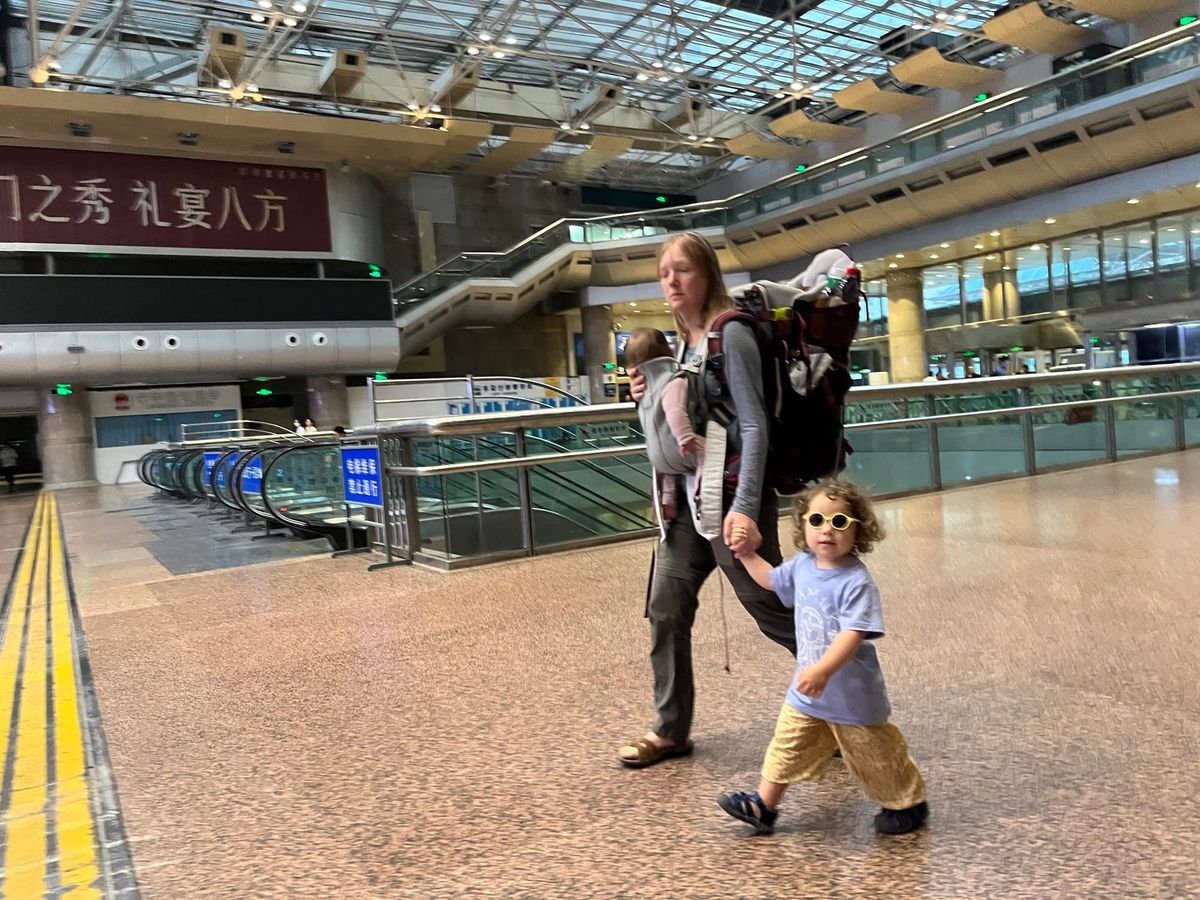
China's high-speed rail network is the best way for a family to see the country — fast, punctual, spotless, and genuinely fun for kids. We've traveled China by train on six trips, starting as early as with a 5 month old baby, and this guide collects everything we've learned, updated with up to date information: how tickets for children work, which class to book, what the stations and trains are like with small kids, and how to keep everyone happy on board.
Child Tickets: How the Rules Really Work
This used to be one of the most confusing (and stressful) parts of preparing for our first train journey in China — and a lot of information you'll find online is still outdated, including the old "free under 120 cm" height rule. That rule is gone. Here is how it works now:
- Under 6 years old: travels free without their own seat, accompanied by an adult with a valid ticket. One free child per adult — if you're travelling with more small children than adults, you'll need to buy child tickets for the extra ones.
- 6 to 13 years old: needs a child ticket (roughly half the adult fare on most trains) with their own seat.
- 14 and older: full adult fare.
If you'd rather your under-6 has their own seat — and trust me, for anyone past 2 years you do — you can simply buy them a child-fare ticket. We always bought a seat for Hanna from about age 2.5: good luck keeping a toddler on your lap for a four-hour journey, and the extra space is wonderful for nap time.
Kids don't need a separate ID — their passport is their ticket, same as yours.
Booking Tickets for the Family
Securing tickets in advance is crucial with kids — you want seats together, and trains genuinely sell out, especially long-distance routes, night trains and anything around Chinese holidays.
Tickets are released 15 days before departure. The best way for families is the Trip.com app:
- You can store the whole family's travel documents in the app, so future bookings take a minute.
- You can pre-book before tickets are released — Trip.com then buys them automatically the moment sales open, which is how you get four seats together on a popular route.
- You can set backup trains and seat classes in case your first choice sells out.
- Cancellation is straightforward in the app, with only a small management fee.
Alternatively, use the official 12306 website or app (cheapest, no fees, English version available — but no pre-booking before release), or a tour operator. For the full walkthrough, see my guide:
Choosing the Right Class with Kids
Second Class (二等座): economical and comfortable, with 3+2 seating per row. For our family of 2+2 with small kids we usually book Second Class — 3 tickets when the kids were tiny, 4 for longer journeys. The seats recline a little and there's enough legroom.
First Class (一等座): more spacious 2+2 seating — but there's a fixed armrest between seats, which makes it harder for a child to lie down across your laps or for the family to snuggle together. For families, it's often less practical than Second Class, not more.
Business Class (商务座): genuine luxury — fully reclining seats, closing cabin, only a handful of seats per carriage. We travelled Business Class once out of necessity, and while it was fun to see (Hanna definitely enjoyed a bit of luxury), the hushed, private atmosphere isn't really made for kids. Plus there you would share a seat with your child so not the most convenient.
For most family trips, Second Class offers the best balance of comfort, togetherness and value.
For overnight journeys on regular trains, a Soft Sleeper (软卧) compartment — four berths and a door you can close — is the family-friendly choice. Kids adore sleeper trains.
At the Station with Kids
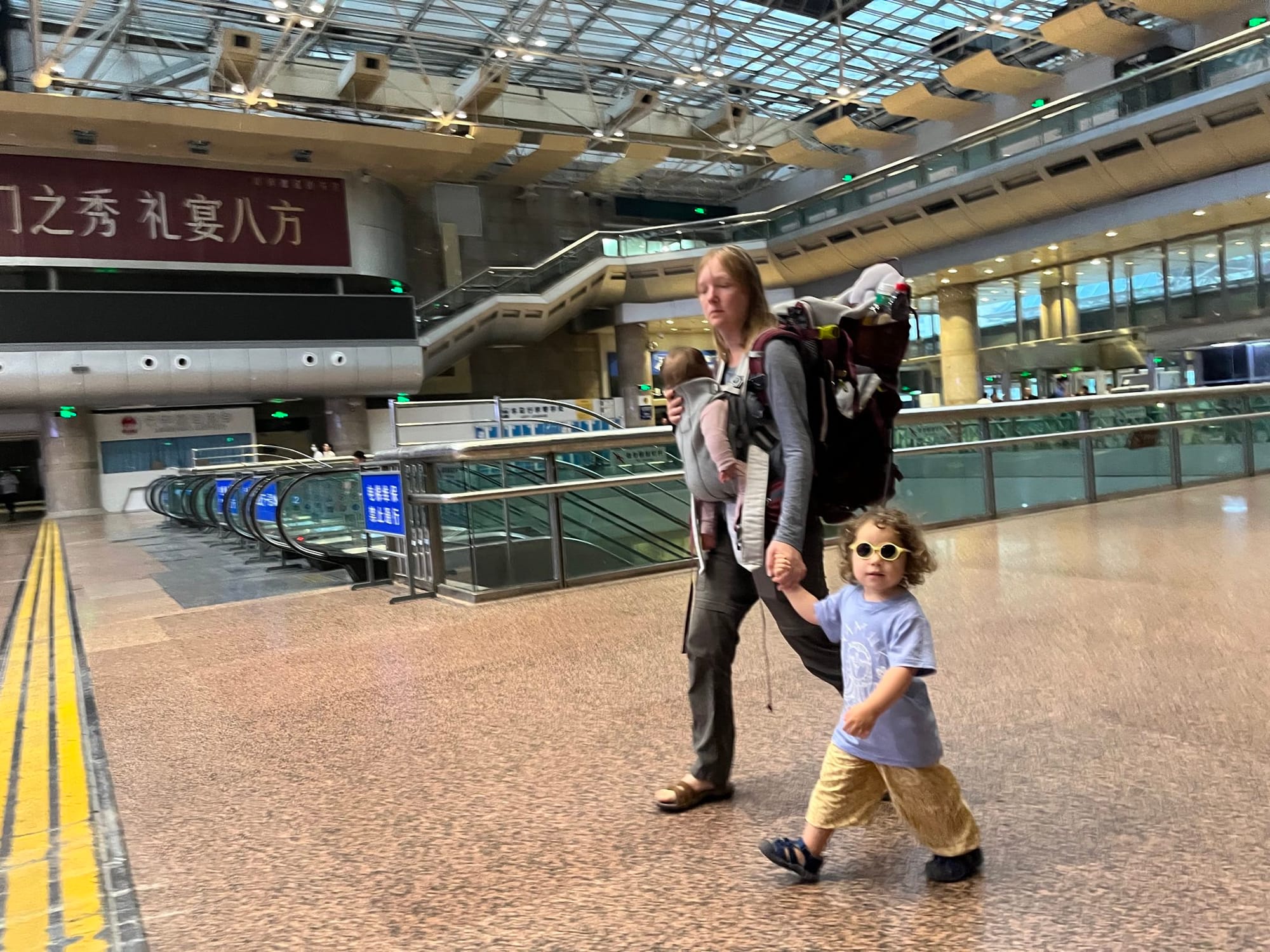
Chinese train stations are vast and busy, but far more family-friendly than European ones once you know the drill:
- Arrive at least 1 hour ahead — stations are often on the city outskirts, and you'll want time for the security check and finding your gate. Boarding starts 20–30 minutes before departure.
- There are no paper tickets — everything is electronic and linked to your passport numbers. Locals use e-gates; foreign passports usually go through the manual gate, so find it early and queue there ahead of boarding.
- Security is airport-style but quicker — bags through a scanner, no need to unpack liquids or electronics.
- All stations have convenience stores for snacks; bigger ones have cafés, tea shops and restaurants. We always let the kids pick a train-station snack purely for the entertainment value.
- Many major stations have nursing rooms with changing tables and family waiting areas — ask at the information desk.
- Free hot water dispensers are everywhere — bring a thermos.
On Board with Kids
Food and Drink
Every high-speed train has a dining car in the middle of the train selling snacks, soft drinks and decent microwaved rice meals (think Kung Pao chicken). A trolley with snacks also passes through the carriages. Still, bring your own snacks and drinks for the kids — plenty of them.
Hot water is free on every train — perfect for instant noodles, tea or preparing baby formula. Because hot water is free, the dining car doesn't sell coffee or tea, so pack a thermos or travel mug!
Toilets and Changing
High-speed trains have both Western and squat toilets in each carriage — clean, usually with paper, but carry your own just in case. The accessible toilet with a baby-changing table is in carriage 5 on every high-speed train — worth knowing before you're pacing the corridor with a wriggling baby.
Entertainment
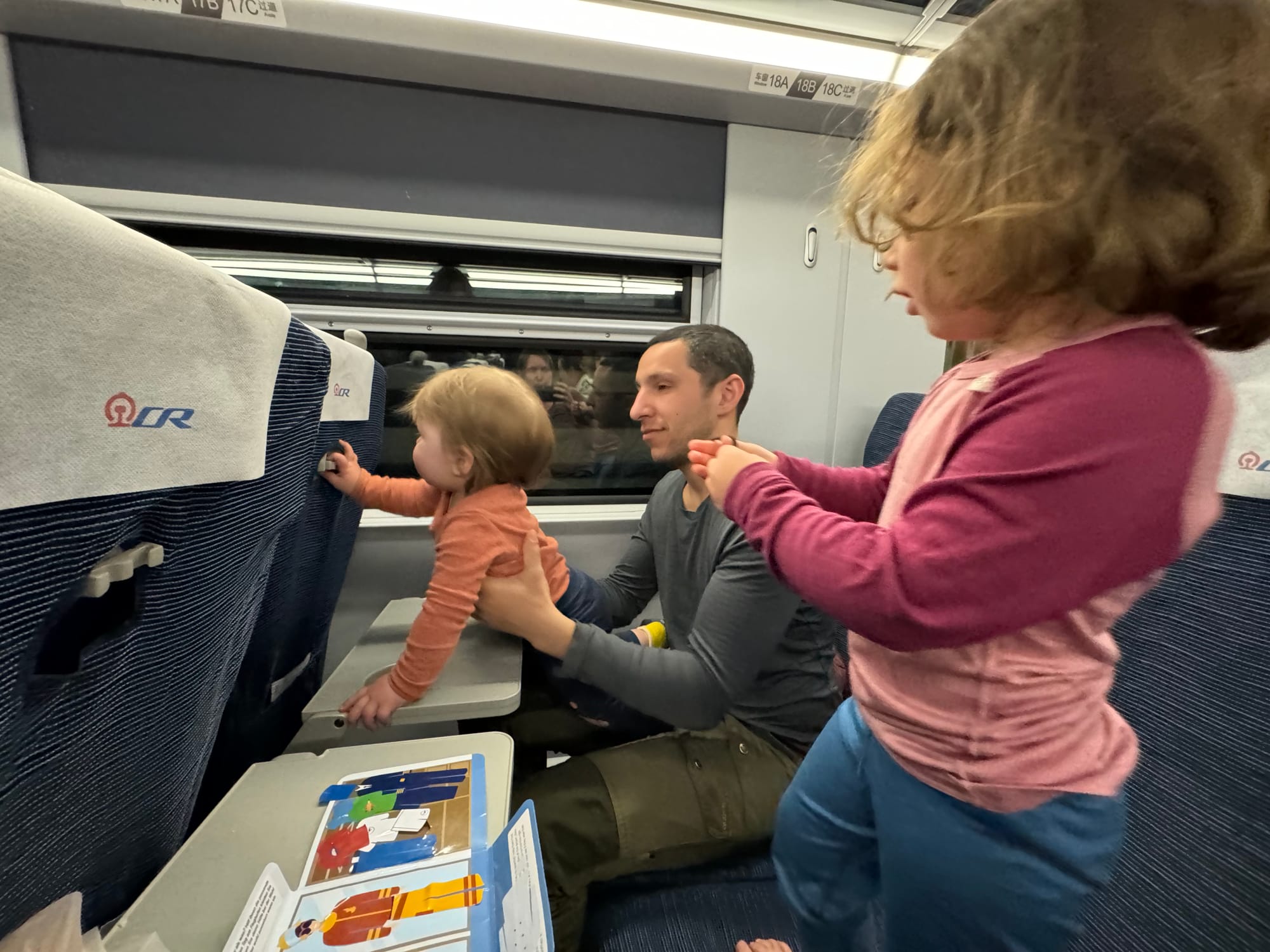
Bring your own entertainment, keep it in your hand luggage, and space out the activities — save the best for last. What has worked for us, by age:
- Baby (0–12 months): soft quiet toys, cloth books, a small mirror, a lightweight blanket for naps. Baby-wearing beats a stroller for getting around the train — and for putting a baby to sleep on board.
- Toddler (1–3 years): an erasable drawing pad, picture books with lots to talk about, stacking cups or a few wooden blocks, a favourite comfort object. Let them carry their own tiny backpack.
- Kindergarten (4–6 years): a special magazine or colouring book bought at the station, sticker and activity books, a small box of Lego, simple games like I Spy — and give them a job, like being in charge of the snack bag or following the journey on a map.
We deliberately avoid screens and noisy flashing toys on trains — they overstimulate, annoy the whole carriage, and every parent knows you cannot take a phone from a child peacefully. Simple, open-ended toys that we don't play with every day work far better.
Our Best Stress-Free Travel Tips
We've learned these by trial and error — and we have many trials, and many errors, under our belts:
- Be organised. Looking after children while digging through a backpack is a recipe for a meltdown (yours). Keep tickets, snacks, wipes and a change of clothes within instant reach. Keep all snacks in one bag — ideally it's empty by the end of the trip.
- Travel light. Everything that is not a must deserves a second thought. On our first family trip we dragged a travel cot around Norway and regretted it at every single station. Most unexpected situations can be dealt with when they happen.
- Snacks are strategy. Slow-to-eat, stomach-friendly things: bread, apples, savoury biscuits, dried fruit in moderation. Skip the sweets — a quick high, then a very long low.
- Become the entertainer. This is what makes travelling with kids tiring — but on a train your hands and head are free, so you can actually play: window-spotting games, made-up stories, I Spy.
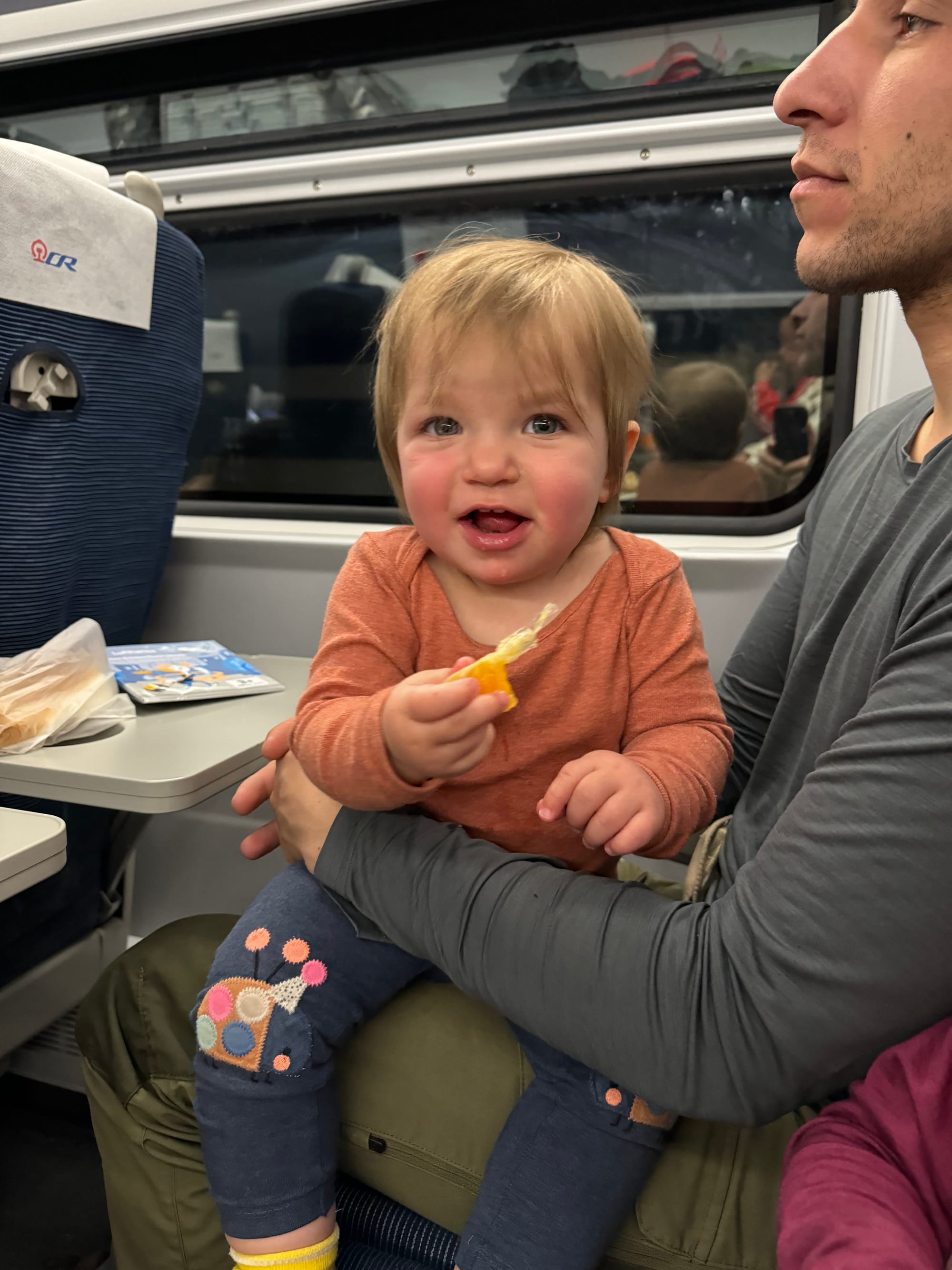
- Embrace social interactions. Other children on the train want to play, and older people want to chat — especially with foreign kids. Once, a fellow passenger simply handed our daughter an orange. Let it happen; the time flies and your child collects wonderful memories. (People do love photographing cute foreign kids — if you'd rather they didn't, a friendly but clear no works fine.)
- Break up very long journeys with overnight stays in interesting cities along the way.
A few Mandarin phrases go a long way: xièxie (thank you), qǐng wèn (excuse me), cèsuǒ zài nǎr? (where is the bathroom?).
Kid-Friendly Routes to Start With
- Beijing → Shanghai: the classic — modern China at 350 km/h, with brilliant kid-friendly attractions at both ends.
- Xi'an → Chengdu: history buffs meet panda lovers, in under four hours.
- Guangzhou → Hong Kong: an exciting cross-border hop with a completely different world at each end.
FAQ
Do children travel free on trains in China?
Children under 6 travel free without their own seat when accompanied by a ticketed adult (one free child per adult), but they must be added to the booking. Children aged 6–13 pay a discounted child fare; from 14 they pay full fare. The old under-120 cm height rule no longer applies to trains.
Does my child need a passport to take a train in China?
Yes — tickets are electronic and linked to each passenger's passport, children included. There's nothing to print; just bring every family member's passport to the station and use the manual gates.
Should I buy a seat for my toddler?
Technically an under-6 can ride free on your lap, but for anything beyond a short hop we recommend buying them a child-fare seat. A four-hour journey with a toddler on your lap is nobody's idea of a holiday, and the extra seat doubles as a nap spot.
How far in advance should I book family train tickets?
Tickets are released 15 days before departure, and popular routes sell out fast. Use Trip.com's pre-booking so the system grabs your seats together the moment sales open — especially around Chinese New Year, Golden Week and summer holidays.
Are there baby changing facilities on Chinese trains?
Yes — every high-speed train has an accessible toilet with a baby-changing table in carriage 5, and major stations have nursing rooms with changing tables.
Is there food for kids on board?
The dining car sells snacks and microwaved rice meals, and free hot water is available for formula, tea or instant noodles. We still recommend bringing plenty of your own snacks — it's half the entertainment.
Book Your Trip
🚄 Book your train tickets — pre-book so seats together are secured the moment sales open
🏨 Find family-friendly hotels
🎫 Book activities & tours
Where to Go Next
Last updated: September 2026 — child ticket rules verified against China Railway (12306) official regulations.