Zhangjiajie National Forest Park: The Avatar Mountains Guide (2026)
💲 Ticket: about ¥230–240 for a 4-day pass (entry + shuttle buses). The Bailong Elevator and cable cars are extra, ¥65–76 per ride
⏱️ Time needed: one full day minimum, two to three is better
🏆 Don't miss: the Avatar peaks at Yuanjiajie, reached by the Bailong Elevator
🚪 Main gate: East Gate at Wulingyuan (there are five, and they're not interchangeable)
🏨 Base: Wulingyuan — you can no longer stay inside the park
👨👩👧 With kids: yes, one day, with a carrier rather than a stroller
🎟️ Tickets: buy the 4-day park pass online
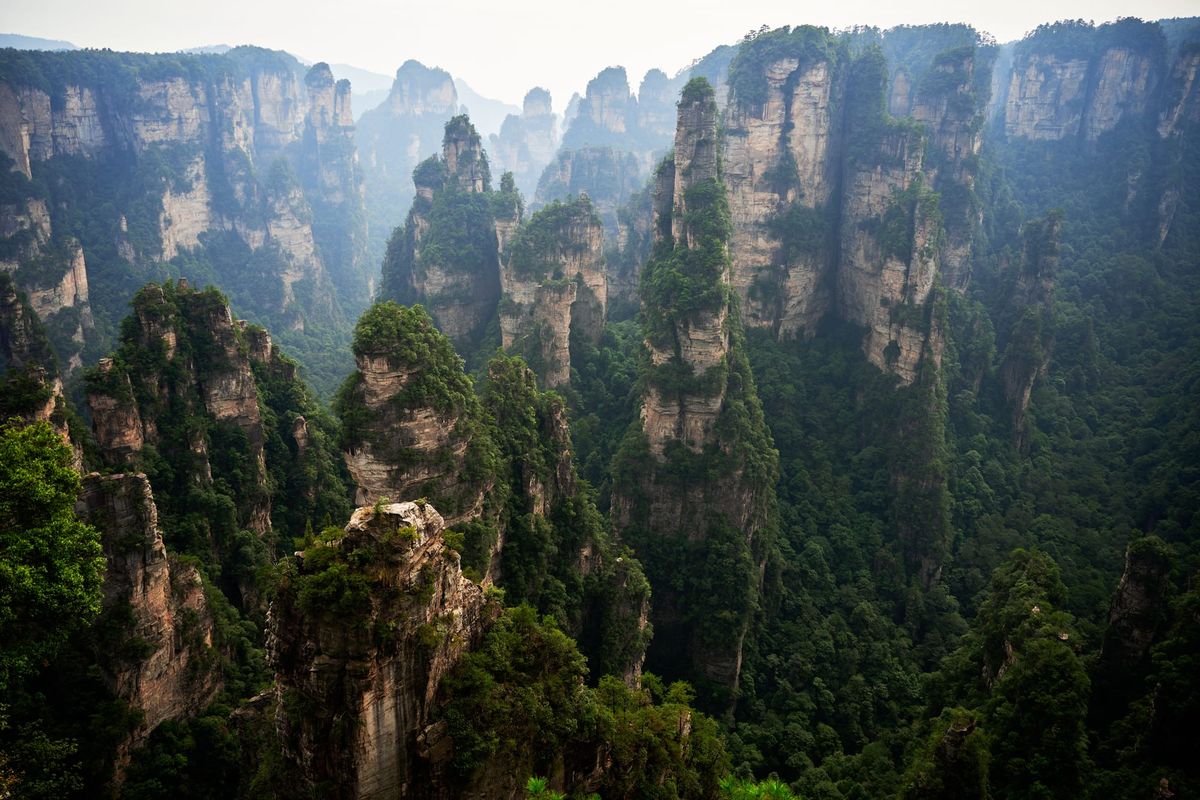
Quick answer: Zhangjiajie National Forest Park is where the "Avatar mountains" are — thousands of sandstone pillars, best seen from the Yuanjiajie area, which you reach by the Bailong Elevator. The park sits about 30 km from Zhangjiajie City inside the wider Wulingyuan Scenic Area, so base yourself in Wulingyuan town by the East Gate, not in the city. The entry ticket is valid for four consecutive days and includes the shuttle buses, but not the elevator or cable cars. Plan at least one full day, and go in with a map and a route — the park is enormous and surprisingly easy to get lost in.
We did this park the hard way: arrived from Changsha mid-morning, took a public bus to a gate we weren't sure about, and walked in tired, hot and without a map. We still saw the peaks, and the Bailong Elevator alone was worth the trip, but we spent more of the day confused than we should have. My husband and I have each been back since, and this is the guide I wish we'd had the first time.

What and where it is
The naming is the first thing that confuses people, so here it is in one go. Wulingyuan Scenic Area is the big UNESCO-listed region. Inside it are several sections — Zhangjiajie National Forest Park, Tianzi Mountain, Yangjiajie and the Suoxiyu valley — but they all sit on one ticket, and everyone just calls the whole thing "Zhangjiajie National Forest Park". That's what this guide covers.
What is not on this ticket: Tianmen Mountain (a separate mountain above Zhangjiajie City), the Glass Bridge and Grand Canyon (about 40 minutes east of Wulingyuan) and Huanglong Cave. Each is its own ticket and, realistically, its own day. If you're still working out how it all fits together, start with our Zhangjiajie travel guide.
The park is roughly 30 km from Zhangjiajie City. A taxi or DiDi takes 40–50 minutes; the public bus from the city's central bus station to Wulingyuan takes about an hour. Most hotels, restaurants and the Charming Xiangxi show are in Wulingyuan town, a 5–10 minute walk from the East Gate.
Tickets: what you actually need to buy
The park's own pricing is more confusing than it needs to be, because the entry ticket and the transport are sold separately. Here's the short version.
- Entry ticket: about ¥230–240 per adult (the price includes a ¥3 insurance fee that some sellers list separately). It's valid for four consecutive days from your first entry, and it includes unlimited rides on the free shuttle buses inside the park. Children under 14 enter free (you pay only the ¥3 insurance), and teenagers and over-60s get a reduced rate.
- Vertical transport, paid per ride: the Bailong Elevator is ¥65 one way, the Huangshizhai cable car ¥65, the Tianzi Mountain cable car ¥72 and the Yangjiajie cable car ¥76. Kids under 120 cm ride the Bailong Elevator free.
- Transport passes: ¥238 for four one-way rides (any mix of the three cable cars and the elevator) or ¥298 for unlimited rides over the four days. There's also an all-in pass at around ¥520–540 that bundles entry with unlimited rides.
My recommendation: if you have one day, buy the entry ticket and pay for two rides (elevator up, cable car down). If you have two or more days, the unlimited transport pass or the all-in ticket pays for itself quickly, and it saves you queuing to buy tickets at every station.
All tickets are real-name, so you'll need your passport both to buy and to enter. In peak season book a day or two ahead online — queues at the ticket windows add up fast.
The gates: decide before you leave your hotel
The park has five gates, the shuttle routes behind them don't overlap, and this is exactly where we went wrong. Pick your gate based on where you're staying and what you want to see first.
- East Gate (Wulingyuan, also called Wujiaoyu) — the main entrance, where most hotels are. Buses from here go straight to the Bailong Elevator and the Tianzi Mountain cable car. This is where you want to start.
- South Gate (the "Forest Park" gate) — the closest to Zhangjiajie City. Best for the Golden Whip Stream walk and the Huangshizhai cable car.
- North Gate (Tianzi Mountain) — a long way out, but a free shuttle takes you straight up to the Tianzi Mountain viewpoints.
- West Gate (Yangjiajie) — the quiet side, with a cable car up to the Yangjiajie area.
- Central gate (Zimugang / Shuiraosimen) — between the two valley areas, useful for the Ten Mile Gallery.
You can exit through a different gate than you entered, which is handy for one-way routes — just make sure you know how you'll get back to your hotel from there.
How the park works (and why people get lost)
Think of the park as two levels. The valley floor has the streams, the flat walks and the Ten Mile Gallery. The mountain top has the big views — Yuanjiajie, Tianzi Mountain and Yangjiajie. The Bailong Elevator and the three cable cars are the connections between the two levels, and on each level free shuttle buses link the stops.
That sounds simple. In practice, the buses are frequent but the routes aren't obvious, signage is hit and miss, and the English on the maps doesn't always match the names at the bus stops. We only found our way out on the first trip because a stranger showed us a paper map he'd picked up at his hotel. So: get a paper map at your hotel or the gate, or screenshot one before you go in, note which gate you entered, and decide your loop in advance. Signal is patchy on the mountain.
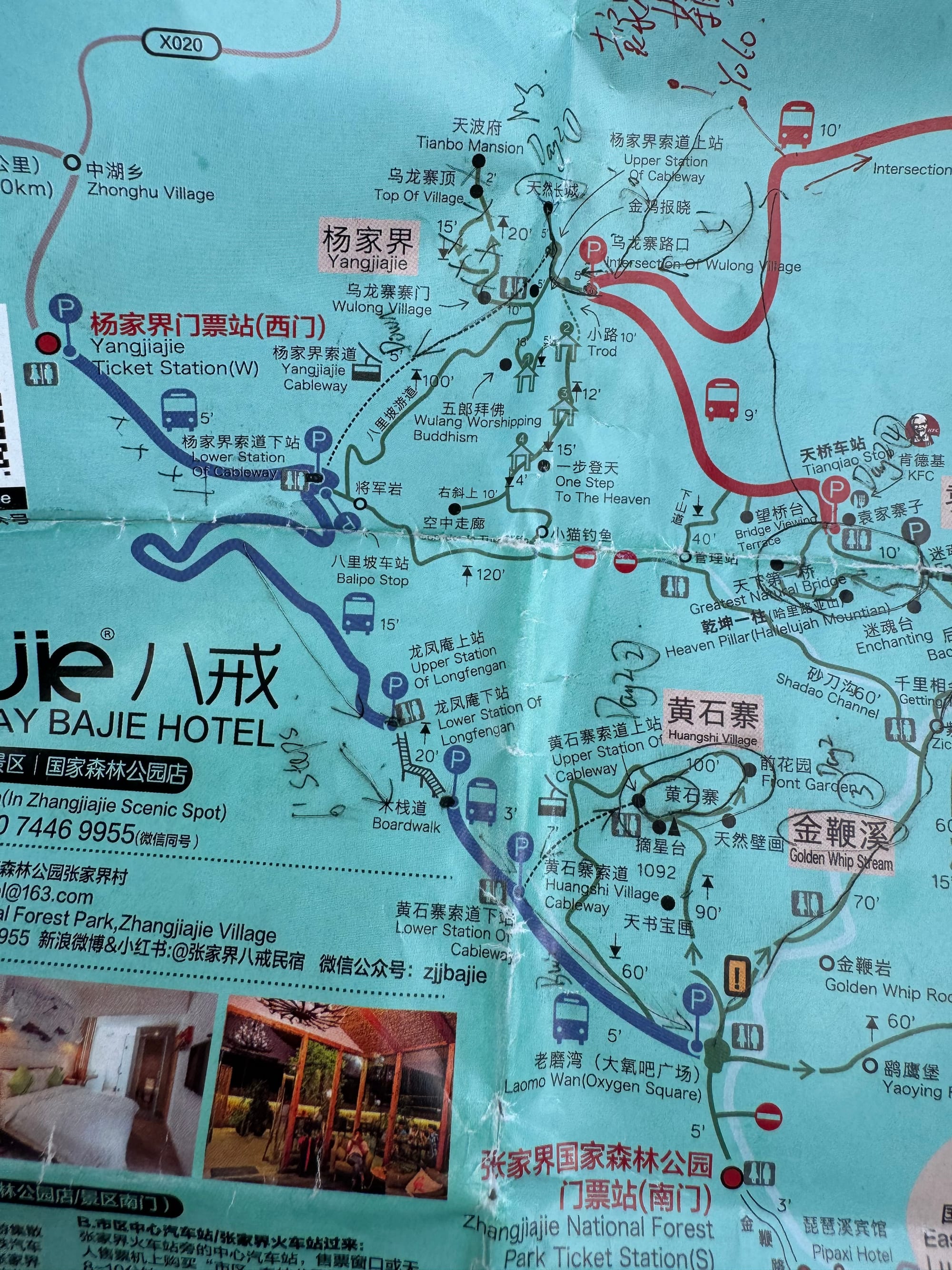
One more expectation to reset: this isn't a wilderness. There are paved paths, roads on the top and the bottom, food stalls at every viewpoint and a KFC next to the Bailong Elevator. The hard part isn't facilities or fitness — it's knowing where you are and getting through the queues.
The main areas
Yuanjiajie and the Avatar Hallelujah Mountain
This is the headline. Yuanjiajie is a platform area on the mountain top with a series of viewpoints over the densest cluster of pillars in the park. The "Avatar Hallelujah Mountain" (its real name is the Southern Sky Column) is the one that inspired the floating mountains in the film, and there's a natural stone arch, the First Bridge Under Heaven, a few minutes further along the path. The walk between viewpoints is short and mostly flat, and the whole area takes 1.5–2 hours with the crowds.
And there will be crowds. The viewpoints are small, everyone wants the same photo, and in peak season the path moves at a shuffle. The trick is to be on the first elevator of the day, or to come late in the afternoon when the tour groups have left.

The Bailong Elevator
A glass elevator built into the cliff face that takes you 326 m up to Yuanjiajie in under two minutes. It's billed as the world's tallest outdoor elevator, and it's the one thing I'd tell everyone to do regardless of how they feel about queues. The ride itself — glass walls, the pillars rising past you — was the moment our kids actually got excited about the park. The busiest time is 9:30–12:00; the queue can easily be 45 minutes then. Early or late, it's a few minutes.
Tianzi Mountain
From Yuanjiajie, a shuttle bus runs along the top to Tianzi Mountain, which has a different angle on the peaks — more spread out, with the famous "sea of peaks" views from Helong Park and the Imperial Brush Peaks viewpoint. Plan 1–1.5 hours. From here the Tianzi Mountain cable car takes you back down to the valley, and a bus returns you to the East Gate. This is the natural end of a one-day loop.
Yangjiajie
The quieter section on the west side, with its own cable car and longer, steeper walks to the "Natural Great Wall" rock formations. Worth it on a second or third day if you want the views with fewer people. Skip it on a one-day visit.
Golden Whip Stream
A flat, paved 5–7 km path along a stream at the bottom of the valley, with the pillars rising on both sides. It starts near the South Gate and takes 2–3 hours at an easy pace. This is the gentlest part of the park and the easiest with children — but keep your snacks packed away, because the macaques here are bold and will take food out of your hands.
Ten Mile Gallery
A short valley with a little sightseeing train that runs its length (small extra fee) or a 40-minute flat walk beside the track. Pleasant rather than spectacular; it's mostly useful because it connects to the Tianzi Mountain cable car.
Huangshizhai
A large plateau on the south side with a loop of viewpoints and its own cable car. There's a local saying that you haven't been to Zhangjiajie until you've been to Huangshizhai, which tells you how the locals rank it — but it's a separate trip from the East Gate side, so it only fits if you have two days or more.

Suggested routes
One day (the loop we'd do now): be at the East Gate when it opens. Shuttle bus to the Bailong Elevator, ride up, walk the Yuanjiajie viewpoints (1.5–2 hours). Shuttle bus along the top to Tianzi Mountain, see the viewpoints (1–1.5 hours), take the Tianzi cable car down, and bus back to the East Gate. With lunch and queues this is 6–7 hours, and you've seen the best of the park without backtracking.
Two days: do the loop above on day one. On day two, enter at the South Gate and walk Golden Whip Stream, then either take the Huangshizhai cable car up for the plateau loop, or continue through the valley to the Ten Mile Gallery and out through the central gate. Alternatively give day two to Yangjiajie if you'd rather have fewer people than more views.
Three days: add Huangshizhai or Yangjiajie, whichever you skipped — or, honestly, use the third day for Huanglong Cave or the Glass Bridge instead. Three full days inside the park is a lot of the same scenery.
Whichever you choose, don't try to do the park on the day you arrive. Settle in Wulingyuan, sort your tickets, see the Charming Xiangxi show in the evening if you like, and start fresh. Our Zhangjiajie itinerary shows how the park days fit with Tianmen and the old towns.
Food, toilets and weather
You don't need to pack a full day of food. There are vendors at every bus stop and viewpoint, proper restaurants near the Bailong Elevator and on the Tianzi Mountain top, and toilets everywhere. Prices are higher than in town but not outrageous. Bring water and a few snacks for the queues, and that's it.
The weather changes fast. Mist here is normal and often beautiful — the pillars appear and disappear in layers — and it usually clears in pulses, so if a viewpoint is clouded over, wait ten minutes before giving up. Bring a light rain jacket even on a clear morning. In autumn and winter it's noticeably colder on the top than in Wulingyuan. Summer is hot, humid and the most crowded; we visited in late September and the bus queues were already long. If you can, come in October–November or in the depths of winter for snow on the peaks.
Visiting with kids
The park works with children, with two adjustments. First, bring a carrier, not a stroller — there are stairs at every viewpoint and bus transfers everywhere, and a stroller is more trouble than it's worth. Second, do one day, not three. The elevator ride and the cable car are the bits our kids remember; the viewpoints themselves meant more to us than to them. Golden Whip Stream is the easiest section with little ones.
Two practical notes: motion-sickness tablets for the bus rides, which are winding, and a buffer day in your plan. Staff let us to the front of several bus queues because we had small children, which isn't guaranteed but was a lifesaver in September. Our full take, including what to do instead of a second park day, is in the Zhangjiajie with kids guide.
Where to stay for the park
You can't stay inside the park anymore — the guesthouses on the mountain top were closed to protect the area — so the closest base is Wulingyuan, a 5–10 minute walk from the East Gate. That's close enough to be on the first elevator of the morning.
Our top pick in Wulingyuan is Qishi Li Cave Homestay — a modern, design-led place opened in 2025, about 10 minutes' walk from the gate, and one of the very few boutique-style options this close to the park. For a reliable, well-priced room right by the night market, Atour Hotel (National Forest Park Entrance) does the job. Families who want a pool after a day of stairs should look at Howard Johnson Neodalle Resort (indoor and outdoor pools, a kids' pool and play areas), or the calmer, courtyard-style Expert Village Yangguang Hotel with spacious family rooms.
If you'd rather trade convenience for quiet, the West Gate (Yangjiajie) side has scenic valley stays like No. 5 Valley Lodge, with an infinity pool facing the peaks. It's about an hour further from the train, so it suits a longer trip. All the options by area and budget are in Where to Stay in Zhangjiajie.
FAQs
How many days do you need in Zhangjiajie National Forest Park?
One full day covers the highlights — Yuanjiajie via the Bailong Elevator, then Tianzi Mountain and a cable car down. Two days let you add Golden Whip Stream and Huangshizhai or Yangjiajie at a relaxed pace. The ticket is valid for four days, but three days inside the park is more than most people need.
How long is the Zhangjiajie park ticket valid?
Four consecutive days from your first entry. The ticket includes the shuttle buses inside the park; the Bailong Elevator and the cable cars are paid separately or through a transport pass.
Is the Bailong Elevator worth it?
Yes. It's the fastest way up to the Avatar peaks and a genuine highlight in itself — a glass lift up a cliff face. Go before 9:30 or after 15:00 to avoid the longest queues.
What's the difference between Zhangjiajie National Forest Park and Tianmen Mountain?
They're separate mountains with separate tickets. The Forest Park has the Avatar pillars and is 30 km from the city, near Wulingyuan. Tianmen Mountain rises directly above Zhangjiajie City and has Heaven's Gate and the glass skywalk. Plan a separate day for each.
Can you stay inside the park?
No. Accommodation on the mountain top has been closed. Stay in Wulingyuan by the East Gate, which is a 5–10 minute walk from the entrance.
Which gate should I use?
For most visitors, the East Gate at Wulingyuan — it's where the hotels are and the buses from it go straight to the Bailong Elevator. Use the South Gate if you're starting with Golden Whip Stream or Huangshizhai.
Plan your Zhangjiajie trip
- 📍 Zhangjiajie travel guide — start here
- 🗓️ Zhangjiajie itinerary — how the park days fit with everything else
- 🎯 Best things to do in Zhangjiajie
- 🏨 Where to stay in Zhangjiajie
- 🚡 Tianmen Mountain guide
- 🌉 Glass Bridge & Grand Canyon guide
- 👨👩👧 Zhangjiajie with kids
- 🎟️ Book park and attraction tickets
- 🚆 Book trains to Zhangjiajie
Final thoughts
The peaks are as good as the photos, and the elevator ride up to them is better than any photo. What the photos don't show is the planning it takes to enjoy them: the right gate, a map in your pocket, an early start and a route you've decided on before the bus pulls away. Get those four things right and the park is a great day out. Get them wrong, as we did, and you'll still see the mountains — just with more wandering than wonder.
This post contains affiliate links. For more information, see our disclosures.